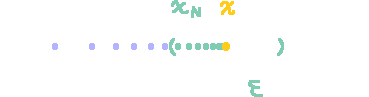
Motivation: Intuitively, a sequence of numbers is just a list of numbers that goes on forever in a particular order. Formally, a sequence of points is a function from the natural numbers to the real numbers. We can visualize sequences by drawing all of their points on the real number line, as above.

Some sequences, like the green one above, look like they're closing in on a single point, which in the drawing is colored yellow. Other sequences do not look like that. The red sequence below, for example, looks like it's just repeatedly doing the same three points over and over again.

Sequences like the green one are called convergent and sequences like the red one are called divergent. More precisely, we say a sequence converges to a number x if whenever we draw an open interval of any size centered at x, the sequence eventually goes inside the interval and never comes back out. We also call the point x the limit of the sequence.

This definition is already pretty good, but in order to make it convenient for actual proofs, we're gonna want rephrase it a bit. We will denote the nth point in the sequence above as xₙ Notice that, in the example above, when n ≥ 7, xₙ and all the points after it will be in the interval. Depending on how big or small we make the interval, this cut off, which we call N, might be a number other than 7. In any case, we can trust that if a sequence (xₙ) converges to x, then for any open interval centered at x, there will be some cut off number N after which all the points will be in the interval. In other words, when n ≥ N, xₙ will be in the interval.
An open interval centered at x is, by definition, the set of all numbers less than a given distance away from x. The given distance in question is called the radius. In the context of sequences, this radius is usually called ε. We want the radius of the interval around x to be of any positive number we'd like. Another way to say this is that we want to allow the radius to be any ε > 0.
Now we can say that if a sequence (xₙ) converges to x, then for any ε > 0, there will be some natural number N such that whenever n ≥ N, xₙ will be in the open interval of radius ε centered at x. Another way to say this last part is that the distance from xₙ to x is less than ε. All that's left to do now is to remember that the distance between two numbers is obtained by subtracting them and taking the absolute value.